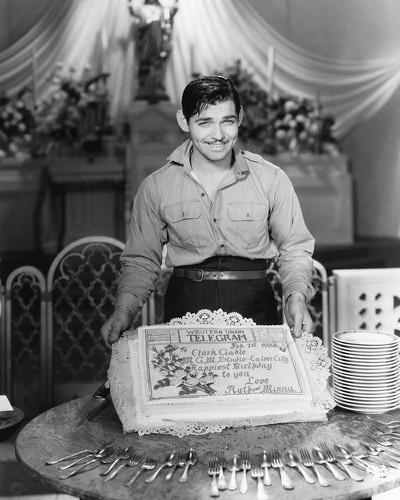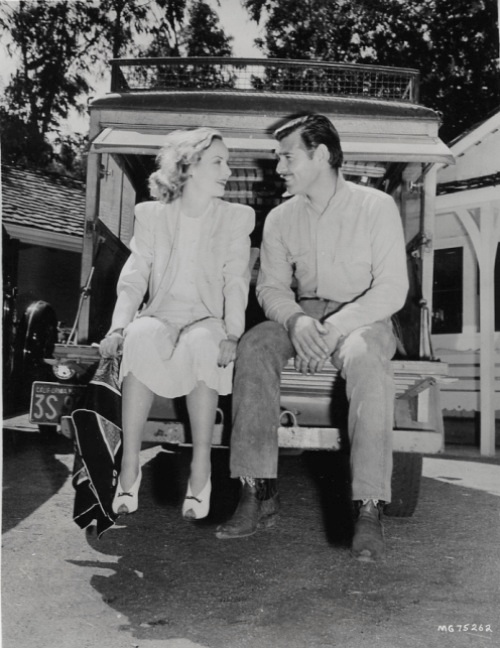
{New Article} Marriage is Career Enough
This syndicated newspaper article was published in November 1941, so just two months before Carole Lombard’s untimely death. There was lots of talk before her death of Clark and Carole buying a larger, more commercial farm in Wyoming or Montana. These plans never came to fruition after Carole’s death. Clark never could bring himself to sell their Encino ranch so ultimately it would be the final home for both of them.
Marriage is Career Enough
by Mayme Ober Peak
Being Mrs. Gable More Important Than Film Roles, Says Carole
Mrs. Gable is the happiest woman in Hollywood. And Carole Lombard doesn’t give a darn whether she ever makes another picture.
Daring to defy the Hollywood jinx on marital happiness, Carole made this statement to me in her portable dressing room on the set of “To Be or Not to Be”–the first picture she’s made in more than a year.
“No matter what career women tell you,” she said, “you cannot find happiness in a career. Pictures are just a side issue to me now. If one comes up that interests me–all right. But I don’t care if I never make another one and certainly I’ll never make a picture that interferes with my married life.”
“Do you mean to say you find life on the Gable farm satisfying enough to make up for the loss of the limelight you bathed in so long?” I asked.
“Gosh, yes! Farm life is the most exciting I’ve ever lived. We don’t sit in the house and listen to the radio. Clark’s running the tractor or building a fence–I’m feeding the chickens and counting the eggs!”
Coming from Carole, this was funny enough. But for her terrific sincerity it might have been ludicrous, for she was costumed as Ophelia–her long golden tresses garlanded with flowers, her streamlined figure lost under a flowing Grecian gown of white and gold.
“We’re shopping for a big ranch now,” she went on, “and this is going to be commercial. Believe me, it will be thrilling when we start raising cattle…Clark and I hunt and fish. We travel a lot, too. We have a gorgeous time!”
While the Gables were on their last hunting trip Producer Alexander Korda sent Carole the script of “To Be or Not To Be,” urging her to read it. Clark was due back anyhow to prepare for his next MGM film and so, Carole said, “I couldn’t resist it. It was a divine comedy. To play opposite Jack Benny was fun enough, but another big inducement was Ernst Lubitsch directing.
“All the 10 years we were on the same lot at Paramount I never had a chance to work under him. He’s marvelous and he’s the greatest actor on the set. Every night I go home and tell the old man (“Pappy” is another of her pet names for the glamorous Gable) all the amazing things Lubitsch has done that day.”
In “To Be or Not to Be” Carole Lombard and Jack Benny are the Lunt and Fontanne of Poland–who do a scene from “Hamlet.” The Clark Gables might aspire to be the Lunt and Fontanne of the movies. They could afford to have their own producing company, such as Mary Pickford and Douglas Fairbanks once had. Their joint salaries approach a million a year. They could make their home represent what Pickfair once stood for in the film capital.
But Carole and Clark had different plans. They started life in a modest farmhouse on a model 70-acre ranch in San Fernando Valley, purchased from Raoul Walsh. They remodeled and enlarged the barns, stables, and built model chicken houses. Gable painted these, as well as the fences, with a spray gun while Carole was having a wonderful time dashing about in the station wagon looking for antiques, or making gingham curtains for the kitchen windows, and hemming the ruffles for the organdy curtains in her bedroom.
I’ll wager she stuck her tongue in her cheek–it’s a mannerism of hers anyhow–when she recalled those boudoir curtains Bill Haines made from a black lace shawl which she had in her former home on upper Hollywood boulevard!
When she met Clark Gable, he was estranged from his second wife, Rhea Langham Gable. She amused Clark–they had a grand time laughing together, outdoing each other’s gags. Clark had never had a woman as a playmate.
He grew up with an inferiority complex which was responsible for his marrying two mature wives. He first married Josephine Dillon, dramatic teacher–she taught him how to act. After their divorce he married the wealthy widow, Rhea Langham, who taught him how to act–in drawing rooms. Unsure of himself then, he needed a helpmate more than a playmate.
Not until Clark reached a certain height and could afford to play, did he meet capricious, prank-loving Lombard. They laughed themselves into love. Each has a sense of humor that lights every hour of life for them.
Carole tells me that instead of going gunning for the gossips who are constantly “separating” them, they laugh the loudest!

You May Also Like
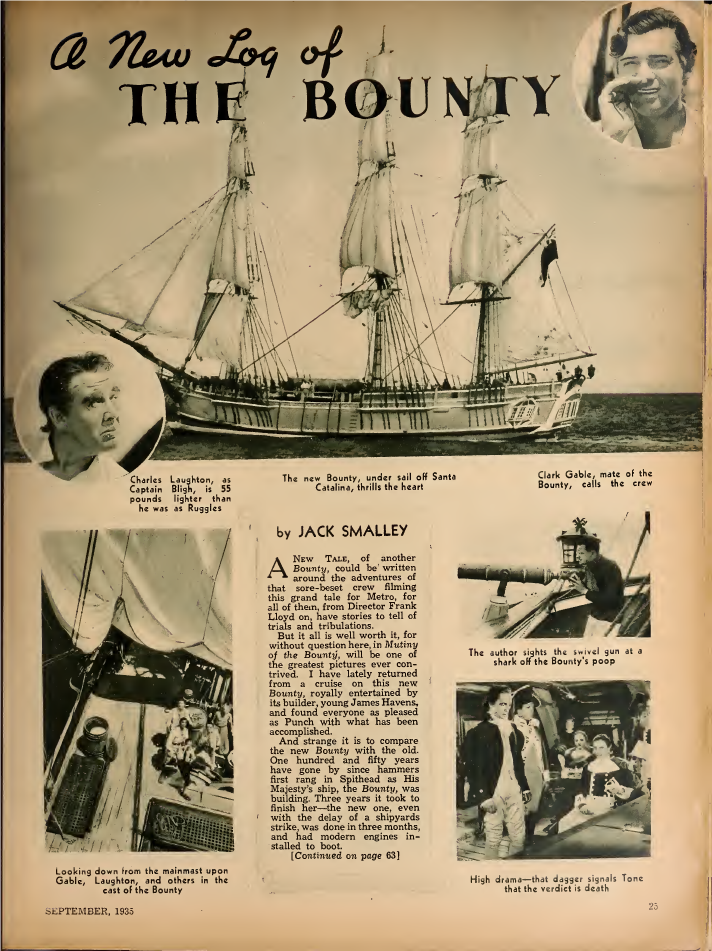
{New Article} 1935: A New Log of The Bounty
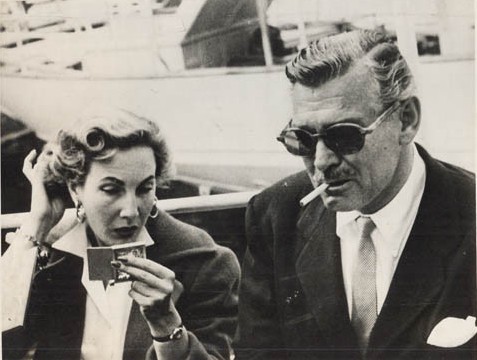
{New Article} 1954: Please Don’t Talk About Me