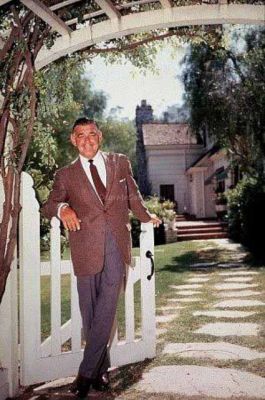
{New Article} The Great Gable Part 1
This is part one of a series of articles that were written for the New York Daily News. Apparently Clark Gable gave them a few quotes, they interviewed some of his friends, were all ready to go to print and then came the surprising news that Clark had eloped with Kay Williams the day before. So they had to squeeze that into the articles as well.
It is hard to find anybody who doesn’t like Gable—even among his ex-wives and girlfriends, practically a small army in themselves.
Even Lady Sylvia Ashley, Wife No. 4 whom Gable eventually locked out of his California ranch, has admitted, grudgingly, that Gable is quite a guy, even though, in her book, he may not be a gentleman.
During this marriage, which brought on a Gable resolve never to marry again, the actor’s friends were wryly amused by efforts of the former chorus girl who became a lady by marriage to make a “gentleman” of a man celebrated for his instinctive courtesy and kindness in a community where these qualities are uncommon.
“Because of Sylvia’s ideas of what constituted a gentleman,” a friend said, “the script of the movie, ‘To Please a Lady,’ dealing with an Indianapolis speedway driver, was practically rewritten.
“Sylvia, who should have known better (she was once married to Doug Fairbanks) objected to Clark being cast as a drunken bum, and insisted that he establish his gentlemanliness by wearing a tux in the picture.”
Over the years, Gable’s leading ladies have been the greatest names in Hollywood, including his third wife, Carole Lombard, who in death is still the unforgettable love of his life—but he has outdrawn them all.
The list reads like a Who’s Who of motion pictures—Garbo, Norma Shearer, Joan Crawford, Loretta Young, Claudette Colbert, Hedy Lamarr, Lana Turner, Harlow, Gardner and Kelly. Nearly all have felt the impact of Gable’s charm during their movie making.
Sophisticated, screen-wise Joan Crawford, who starred opposite Gable in eight movies, including “Possessed” and “Dancing Lady,” from 1931 to 1940, once confessed that she was so smitten by Gable that she crawled fearfully into a shell.
“I was very much in love with Clark,” she said, “but was afraid to admit it. I always had the feeling he cared more for the chase than the prize.”
Gable professes a preference for the older, more sophisticated type woman of mature experience. That accounts, perhaps, for his two early marriages to older women—to Josephine Dillon, a theatrical director, who, at 37, was 14 years older than he at the time of their marriage, and to her successor, Maria (Ria) Langham, a Texas socialite, who was 11 years older.
Kay Williams Spreckels, his latest wife, has been a friend for 17 years, between their respective marriages, and though still attractive and shapely, is pushing 40—the age that Gable seems to prefer, no matter what age he is.
This attitude toward older women is no pose. Shortly after the abdicated King of MGM came onto the 20th Century lot, a studio official suggested that he date Marilyn Monroe, 20th’s major contribution to Kinsey lore.
The famous Gable grin broke out from ear to ear. “What,” the Great Lover demanded, “would a guy like me be doing with a girl like that?”
You can read the article in its entirety in The Article Archive


You May Also Like
{New Article} 1935: Behind the Scenes with Joan, Clark and Bob
{New Article} 1949: Clark Gable’s Secret Romance
