1955: The Great Gable Part 1
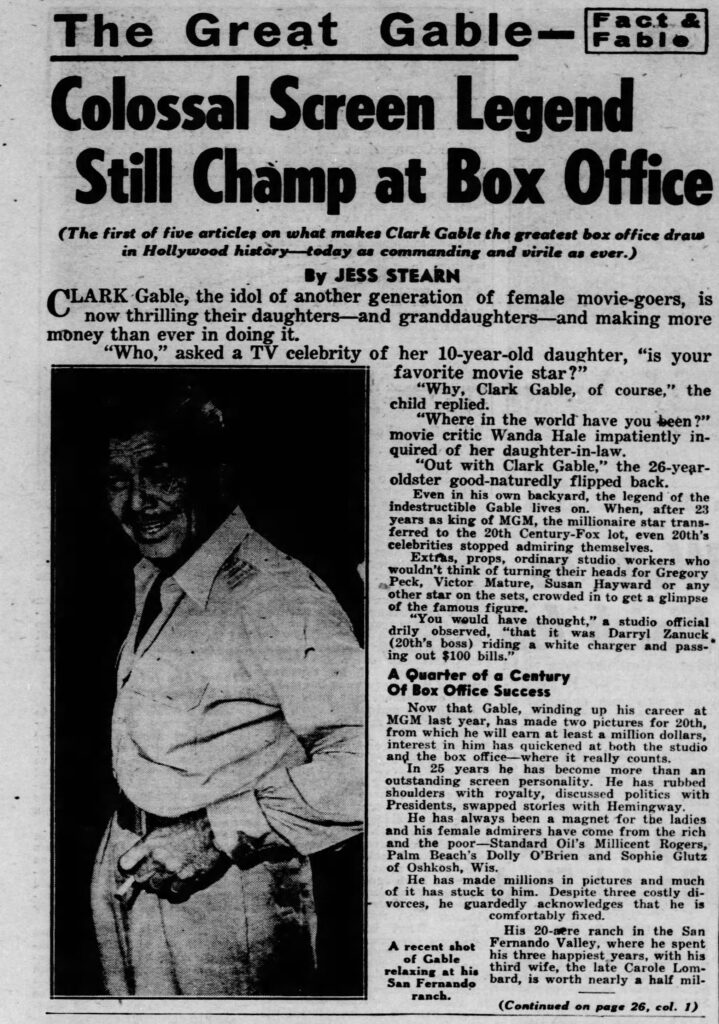
The Great Gable
Part 1: Colossal Screen Legend Still Champ at Box Office
By Jess Stearn
New York Daily News
July 12, 1955
Clark Gable, the idol of another generation of female movie-goers, is now thrilling their daughters—and granddaughters—and making more money than ever doing it.
“Who,” asked a TV celebrity of her 10-year-old daughter, “is your favorite movie star?”
“Why, Clark Gable, of course,” the child replied.
“Where in the world have you been?” movie critic Wanda Hale impatiently inquired of her daughter-in-law,
“Out with Clark Gable,” the 26-year-oldster good-naturedly flipped back.
Even his own backyard, the legend of the indestructible Gable lives on. When, after 23 years as king of MGM, the millionaire star transferred to the 20th Century Fox lot, even 20th’s celebrities hoped admiring themselves.
Extras, props, ordinary studio workers who wouldn’t think of turning their heads for Gregory Peck, Victor Mature, Susan Hayward or any other star on the sets, crowded in to get a glimpse of the famous figure.
“You would have thought,” a studio official drily observed, “that it was Darryl Zanuck (20th’s boss) riding a white charge and passing out $100 bills.”
A Quarter of a Century of Box Office Success
Now that Gable, winding up his career at MGM last year, has made two pictures for 20th, from which he will earn at least million dollars, interest in him has quickened at both the studio and the box office—where it really counts.
In 25 years he has become more than an outstanding screen personality. He has rubbed shoulders with royalty, discussed politics with Presidents, swapped stories with Hemingway.
He has always been a magnet for the ladies and his female admirers have come from the rich and the poor—Standard Oil’s Millicent Rogers, Palm Beach’s Dolly O’Brien and Sophie Glutz of Oshkosh, Wis.
He has made millions in pictures and much of it has stuck to him. Despite three costly divorces, he guardedly acknowledges that he is comfortably fixed.
His 20-acre ranch in the San Fernando Valley, where his spent his three happiest years, with his third wife, Carole Lombard, is worth nearly a half million; he is building another home in the desert at Palm Springs, and if he never makes another dime he can retire in ease.
Though he has parted irrevocably from MGM, he can start drawing a lifetime pension of $31,000 annually beginning next year, or by waiting 10 years, which seems likely in view of his present enormous income, will get $49,000 a year for the rest of his life. Or else he can collect more than $400,000 in a lump.
Known as Old Destructible to friends, he has always lived dangerously, racing souped-up cars, hunting big game, flirting with love. In World War II, enlisting at 41 as an Air Force private, he rose to major. He volunteered for combat duty and got it.
Even in the Army, the great leveler, he was a celebrity. The doctors examining him asked for his autograph. GIs were constantly testing his mettle in training. When he was flying missions over Germany. Air Reischsmarshal Herman Goering offered a large cash bonus, a long furlough and a promotion to any German pilot lucky enough to bring him down alive.
MOGAMBO, TALL MEN are Packing Them In
No, after all these exploits, the Gable career, which had been in a postwar shadow, shows signs of becoming bigger and better than ever—at any rate, richer.
Gable never rode higher. Not since his memorable Rhett Butler in “Gone with the Wind,” has he been in greater demand at the studios.
One of his last MGM efforts, “Mogambo,” a remake of a movie he made 21 years before, is still surprising and discomfiting his old bosses with its success. “The Tall Men,” a robust Western just completed with busty Jane Russell for 20th, is already stirring comparison with Gable’s lusty prewar movies with the late Jean Harlow.
Gable, a $7,000-a-week star for years, is making more money than ever. “The Tall Men,” in which the Gable-Russell byplay makes the Old West seem like a helluva cozy place, is expected to run Gable’s 10% of the gross well over the half million mark and may even make him a million.
Gable, who likes a buck as well as the next guy, wonders how long this sort of thing has been going on. Ruefully, he recalls that producer David Selznick had to give MGM half of “Gone with the Wind” just to get Gable for the picture.
At his present percentage deal, Gable would have made $10 million from the film epic, which already has done an estimated $100 million at the box office and is still going strong. Instead, he got something like $40,000 in salary.
But it is never too late to become a multi-millionaire, if you’re a Gable.
“Right now,” said a producer, “if Hollywood had the moon, Clark could slice it up any way he wants.”
After catching snatches of “The Tall Men,” due for September release, a producer, dickering with the star, we asked what Gable could get for his next picture. His wry reply: “Anything he wants.”
Abroad He Symbolizes Devil-May-Care Yank
This is a particularly astonishing tribute, since, aside from “Mogambo,” featuring Grace Kelly and Ava Gardner, Gable has had no recent notable successes.
However, his popularity, resting wholly on his personal impact on the movie-going public, has survived, particularly abroad, where he symbolizes the heroic, devil-may-care American.
There is little question that Gable, because of a succession of poor pictures, has lost the generation that has grown up since the war. But with the story-wise star now able to pick his spots, there is a conviction in Hollywood that the ageless actor will never stop making winners.
“The trouble with Gable,” a director notes, “was that he was box office for so long that all a studio thought all it had to do was get him before a camera and grind out the dough.”
His career is unique in Hollywood. After 25 years of charming the ladies, he is the biggest box office draw in film history, his 50-odd pictures having grossed some half-billion dollars throughout the world.
All his movies, even the ones he groaned over, made money, with the exception of “Parnell,” where he was miscast as an Irish patriot in a movie that had even the Irish sneering.
Success sometimes came in spite of himself. The comedy hit, “It Happened One Night,” which got him his only Oscar, and “Mutiny o the Bounty,” perhaps his won favorite performance, were made after he had been virtually blackjacked into the parts.
It has worked the other way, too. He has passed up starring roles, in “Quo Vadis” and “Knights of the Round Table,” which practically rebuilt the career of the star who eventually made them—Robert Taylor.
How Gable Got Rid of His Only Oscar
Taylor, duly grateful, has remarked: “I guess I owe it all to Clark for reactivating my career.”
Even “Gone with the Wind,” the greatest money maker of all time, brought its disappointment. Gable somehow failed to win an Academy Award of that effort.
“Clark,” a friend observed, “suited the Rhett Butler part so well that it must have seemed like he didn’t have to do anything but play himself.”
It may be sheer coincidence, but Gabe’s lone Oscar no longer graces his trophy room. One day a small boy, the son of a friend, was admiring it, and Gable told him to wrap it up and take it home.
“When things no longer hold a meaning for Clark,” a friend noted, “he doesn’t want them around—whatever they are.”
At 54, the secret of the great stars renewed success seems to lie in his refusal to grow old—in a singular boyishness which women find so singularly devastating.
Film star Deborah Kerr, unimpressionable English, once explained: “When he breaks into that little boy grin, then I want to take him like this…”
It isn’t only stars that Gable sends. A producer, who has followed the Gable legend from its start, asserts that Gable fills the secret need of millions of serious-minded women who have an unsatisfied craving for the great romance.
Hardened in Lumber Camps, He Wears Well
“Clark’s,” he observed, “is no lightheaded bobby sox appeal. One time he was visiting a Mexico church and almost ran into a middle-aged woman and her two grown daughters on the steps. Without a word, one of the daughters, looking up, quietly put her arms around Clark, kissed him gently and went on.”
Hardened in his youth in the lumber camps and oil fields, Gable had the quality of wearing well, though he helps nature along with a rigorous “spartan” diet, plenty of hunting and fishing, and, as a friend puts it, only the best whisky.
After two years of knocking around Europe, he had to lose 30 pounds for “Soldier of Fortune,” his first picture away from the MGM lot. “I went to the doctor,” he recalls, “and asked him about trimming down with exercise. He said: ‘Sure—exercise a little with power at the table.’”
Currently, Gable’s springy 6-foot-1 frame carries a taut, powerfully muscled, flat-bellied 195 pounds, the weight at which he first broke into pictures in 1930.
Although there are new lines in his weather-roughed visage, he looks an indeterminate age and any 35-year-old man in peak condition would be happy to have his face and physique—not to mention his bankroll. He has gone distinctively gray at the temples, and with his distaste for phoniness, would like to appear that way in pictures.
Hollywood producers, however, have persuaded him that his public prefers to see him with young girls. And that it is therefore more seemly for him to darken his hair for screen romances with the present crop of film beauties—Gardner, Kelly and Jane Russell—all of whom seem content with him in real life just as he is.
Off or on the screen, there is essentially little difference in the Gable charm, which commonly leads to the mistaken illusion that Gable is not a practiced actor but is merely playing himself.
Anything he does movie-wise, he can do—and usually does—privately, whether it’s making a girl forget what a mother told her or performing herculean feats, such as lifting a strong man by his ears, as he does in “Solider of Fortune.”
Although that film is not likely to drag down an Academy Award, it is considered good Gable. A survey shows that it is outdrawing the widely-heralded “A Man Called Peter” 3 to 2 at the box office. There’s no secret about it—it’s Gable.
“When you get your first glimpse of Clark in that white suit, squinting up into the sun,” sighed a longtime female admirer, “that’s the price of admission right there.”
While possessing an innate dignity, he is never stuffy. He has a roguish rumor, which rips away at pretense and sham. Once, training for a fight picture, he bowled over a sparring partner, a professional, with a freak punch. Later, the pugilist was quoted as alibiing that Gable could be a champ if he turned pro.
Gentleman, It Seems, Are Born, Not Made
When the story got back to him, Gable cracked: “I must have knocked him senseless.”
It is hard to find anybody who doesn’t like Gable—even among his ex-wives and girlfriends, practically a small army in themselves.
Even Lady Sylvia Ashley, Wife No. 4 whom Gable eventually locked out of his California ranch, has admitted, grudgingly, that Gable is quite a guy, even though, in her book, he may not be a gentleman.
During this marriage, which brought on a Gable resolve never to marry again, the actor’s friends were wryly amused by efforts of the former chorus girl who became a lady by marriage to make a “gentleman” of a man celebrated for his instinctive courtesy and kindness in a community where these qualities are uncommon.
“Because of Sylvia’s ideas of what constituted a gentleman,” a friend said, “the script of the movie, ‘To Please a Lady,’ dealing with an Indianapolis speedway driver, was practically rewritten.
“Sylvia, who should have known better (she was once married to Doug Fairbanks) objected to Clark being cast as a drunken bum, and insisted that he establish his gentlemanliness by wearing a tux in the picture.”
Over the years, Gable’s leading ladies have been the greatest names in Hollywood, including his third wife, Carole Lombard, who in death is still the unforgettable love of his life—but he has outdrawn them all.
The list reads like a Who’s Who of motion pictures—Garbo, Norma Shearer, Joan Crawford, Loretta Young, Claudette Colbert, Hedy Lamarr, Lana Turner, Harlow, Gardner and Kelly. Nearly all have felt the impact of Gable’s charm during their movie making.
Sophisticated, screen-wise Joan Crawford, who starred opposite Gable in eight movies, including “Possessed” and “Dancing Lady,” from 1931 to 1940, once confessed that she was so smitten by Gable that she crawled fearfully into a shell.
“I was very much in love with Clark,” she said, “but was afraid to admit it. I always had the feeling he cared more for the chase than the prize.”
Gable professes a preference for the older, more sophisticated type woman of mature experience. That accounts, perhaps, for his two early marriages to older women—to Josephine Dillon, a theatrical director, who, at 37, was 14 years older than he at the time of their marriage, and to her successor, Maria (Ria) Langham, a Texas socialite, who was 11 years older.
Kay Williams Spreckels, his latest wife, has been a friend for 17 years, between their respective marriages, and though still attractive and shapely, is pushing 40—the age that Gable seems to prefer, no matter what age he is.
This attitude toward older women is no pose. Shortly after the abdicated King of MGM came onto the 20th Century lot, a studio official suggested that he date Marilyn Monroe, 20th’s major contribution to Kinsey lore.
The famous Gable grin broke out from ear to ear. “What,” the Great Lover demanded, “would a guy like me be doing with a girl like that?”