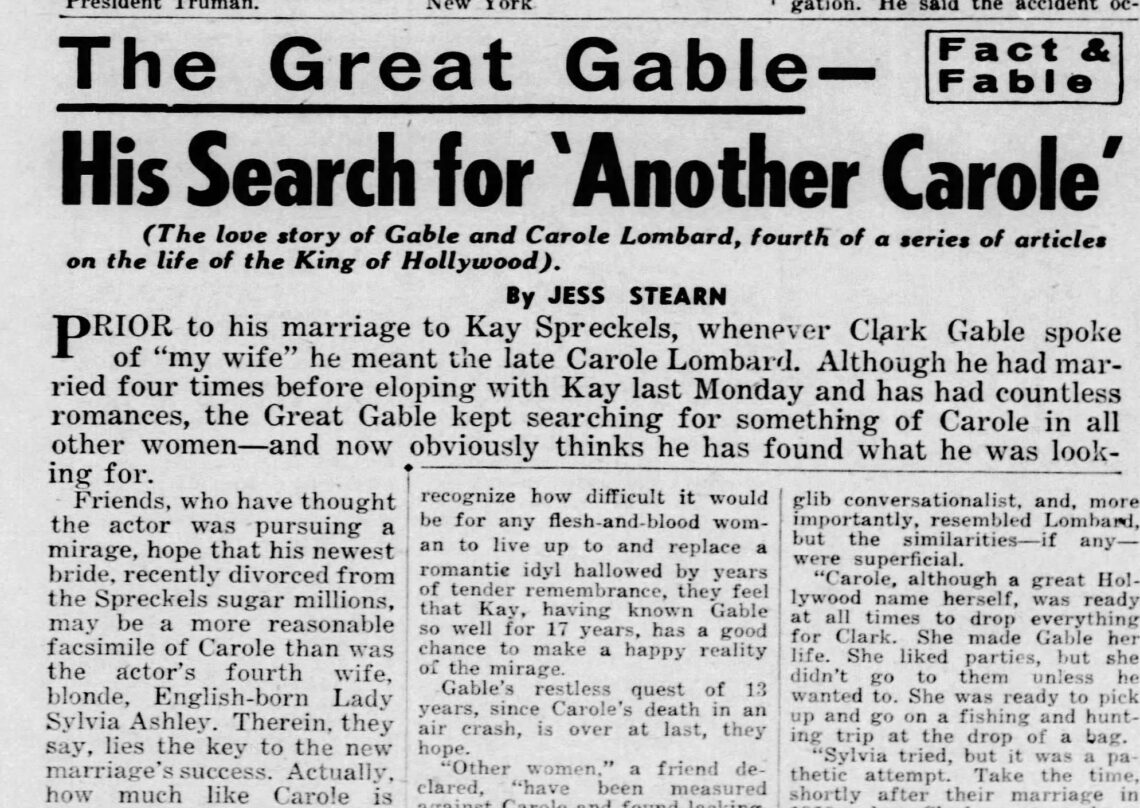
1955: The Great Gable Part 4
The Great Gable
Part 4—His Search for ‘Another Carole’
By Jess Stearn
New York Daily News
July 15,1955
Prior to his marriage to Kay Spreckels, whenever Clark Gable spoke of “my wife” he meant the late Carole Lombard. Although he had married four times before eloping with Kay last Monday and has had countless romances, the Great Gable kept searching for something of Carole in all other women—and now obviously thinks he has found what he was looking for.
Friends, who have thought the actor was pursing a mirage, hope that his newest bride, recently divorced from the Spreckels sugar millions, may be a more reasonable facsimile of Carole than was the actor’s fourth wife, blonde, English-born Sylvia Ashley. Therein, they say, lies the key to the new marriage’s success. Actually, how much like Carole is Kay?
Like Sylvia, Kay resembles Carole in her blonde comeliness, but unlike Sylvia, she likes to do the things Gable does, or at least, as with Carole, effectively appears as though she does.
Although Gable’s intimates recognize how difficult it would be for any flesh-and-blood woman to live up to and replace a romantic idyl hallowed by years of tender remembrance, they feel that Kay, having known Gable so well for 17 years, has a good chance to make a happy reality of the mirage.
Gable’s restless quest of 13 years, since Carole’s death in an air crach, is over at last, they hope.
“Other women,” a friend declared, “have been measured against Carole and found lacking. Clark didn’t remarry until seven years after Carole was killed in that plane crash, and then perhaps without realizing it, he thought he saw something of Carole in Sylvia Ashley.
“Lady Ashley was pretty, important in the café society set, a glib conversationalist, and more, importantly, resembled Lombard, but the similarities—if any—were superficial.
“Carole, although a great Hollywood name herself, was ready at all times to drop everything for Clark. She had made Gable her life. She liked parties, but she didn’t go to them unless he wanted to. She was ready to pick up and go on a fishing and hunting trip at the drop of a bag.
“Sylvia tried, but it was a pathetic attempt. Take the time, shortly after their marriage in 1950, when Clark went on location for the making of ‘Across the Wide Missouri.’
“It was pretty rough going for Sylvia, who was used to camping out in the Colony or 21.
“She had an icebox brought in to make cabin life more comfortable, and had trees and shrubbery planted to improve the natural scenery. The studio made publicity photos showing Sylvia cooking, but she forgot to remove the sparklers from her fingers.”
Gable’s ranch at Encino, where he had spent his happiest years with Carole, was a particular challenge to the former showgirl who had married into the English—and Hollywood—nobility.
“Everywhere she looked,” the friend recalled, “it seemed she was surrounded by Carole’s presence. There was the long pine table in the dining room that Carole and Clark had so much fun making ‘an antique,’ scarring it with cigarettes and hammering it with chains; the drinking mugs—everything that reminded Gable of the wife he still loved.
She Had to Change The House Over Too
“So, naturally, Sylvia had to change things, just as she was trying to change over Gable. She added a guest house, feminized the rooms, which Carole had kept as Clark liked them, and then she took off for England to bring back some of her genuine antiques. She did a pretty good job, but it looked more like Mayfair than Encino.
“Gable gave her a free hand for a while. Finally, when she wanted to fire Clark’s old houseman, a favorite of Carole’s, and install an English butler, he put his foot down.”
And when Sylvia, tiring of Carole’s competition, wanted to move to more fashionable Bel Air or Beverly Hills, the actor flatly balked.
Gable, a frugal figure despite the millions he has earned, couldn’t accept Sylvia’s extravagances. “He couldn’t see any reason for her having a personal maid,” the friend observed, “when she seemed quite capable of drawing her own bath.”
Sylvia complained she got little out of Clark during their marriage, and that she even shared household expenses. Gable, the Great Romantic to millions, never gave her a present, she declared, but once, during the flush of their honeymoon, they bought a diamond necklace for her dog.
Gable himself has said that three weeks after the elopement, in December 1949, he discovered he had made a mistake—a mistake he was to live with for a while.
“Carole had subordinated every desire to Gabe’s,” an intimate observed, “and was happy doing it. Sylvia couldn’t be happy unless Gabe was living her way, the way she fancied a gentleman should.
“Gabe has few close friends, and while he likes people generally, he loves his privacy. Sylvia didn’t seem to realize this or it didn’t square with her ideas of the county squire.
“Toward the end of his life, Clark’s widowed father married again, and Clark wanted him near him. He was his only living blood relative. But as much as Gable adored his father, he got him a separate house in Coldwater Canyon, below Clark’s own place in the San Fernando Valley.
Sylvia, however, brushing aside his wishes for seclusion, brought members of her own family to Encino.
“After I lost Carole,” Gable explained, “I didn’t mix much. I liked my own home. I didn’t like a family underfoot—even my own.
Flock of Doves Was Gable Peace Offering
“And while Sylvia’s sister and her children didn’t live much at the ranch, they were there a good deal of the time. A man’s home is his castle, even though mine happens to be a rather simple ranch.”
Although the marriage was on the rocks in a year, it didn’t wind up in divorce until April 1952.
“Sylvia,” a mutual friend observed, “was—and is—a remarkably fascinating woman, who has charmed five husbands, including two English noblemen and Hollywood’s two greatest figures—the elder Douglas Fairbanks, perhaps the only actor in Hollywood ever bigger than Gable, and the King Gable himself.
“Don’t sell Sylvia short. She is consummately charming, with the verve and vitality of a woman years younger. She had something that rich, famous husbands found extremely desirable. You must remember that Fairbanks, married to Mary Pickford, gave up Hollywood’s most celebrated marriage and top social position to marry her. He was a great athlete, and vigorous, but keeping up to Sylvia was demanding.
“It was nothing for Fairbanks to play 36 holes of golf a day before he married Sylvia. But soon, after following Sylvia’s busy social calendar, he was playing 18, then nine, and it wasn’t long before he had lost all of his old bounce.
“His worried friends would get Doug on cruises with them, but as soon as he got back to shore he’d head straight for Sylvia. She was a real charmer.”
Life With Carole: Wonderful Turbulent
With Lombard, the elegant hoyden, married life was wonderfully turbulent for Gable. Even their original meeting was typically stormy—but tender. Although they appeared together in a picture, “No Man of Her Own,” in 1932, Gable and the blonde comedienne, divorced from actor William Powell, didn’t meet socially for another six years, when they promptly clashed at a dance.
The next morning a peace offering arrived from Carole, a flock of doves. That set the pattern for the future, with Carole sending doves whenever they quarreled.
“They were the perfect match,” an intimate relates, “and no man could have been prouder of his wife. After they came back from the Atlanta premiere of ‘Gone with the Wind,’ everybody was talking about the picture and the great celebration—everybody but Clark; he could only talk about Carole.
“He was a like a schoolboy talking about his first girl. He kept repeating, ‘You should have seen the way they looked at Carole. You never sawy anybody so beautiful.’”
They were constantly amusing each other with harmless practical jokes. When Gable was struggling with a dance routine for “Idiot’s Delight,” Carole sent him a ballet outfit, and for Valentine’s Day a beat-up old white jalopy covered with red hearts. Gable souped up the “tin can’ and raced it for a year.
Carole called him Pappy and he called her Mrs. G or Ma. “They were like a couple of kids in love,” another friend recalled. “Clark couldn’t bear even brief separations from her. He even bought a trailer so she could go to Bakersfield, Calif., on trips with his all-male hunting club. Carole was such a great sport the other members made an exception for her.
“One night, Carole was in the trailer, and Clark, playing cards with the boys, started to yawn and announced he was ready to turn in.
“Five minutes after he left, there was a loud crash and everybody ran out to investigate, The trailer, jolted off its blocks, had crashed to the ground. Clark and Carole, smothered in blankets, were laughing so hard they couldn’t talk.”
How Mrs. G. Answered A Beauty’s Challenge
With Hollywood sirens gunning for Gable, marriage or no marriage, Carole put up the No Trespassing signs. One day the report got back to the blonde spitfire that a well-known screen beauty, then making a picture with Clark, had announced she was taking him away from Lombard.
Without further ado, Carole walked onto an MGM set and, observing Gable doing a love scene with the self-proclaimed love pirate, coolly stalked up to her and kicked her backside.
Then, turning to the director, Carole announced:
“Listen, either this —-is taken out of the picture, or Gable doesn’t work.”
Gable has never fully recovered from Carole’s tragic death in 1942.
During the war, while flying bombing missions over Germany, Gable wore a chain around his neck. It held a small box in which were Carole’s jeweled ear clips. They had been found beside her body on the Nevada mountainside.
He has tried to keep things as she liked them. Their household staff is still intact, including Jean Garceau, his secretary and friend, who filled the same role for Carole before the marriage; Martin, his Negro houseman, and the semi-invalided caretaker of Encino’s 20 acres.
The war provided the backdrop for Carole’s going. The day after Pearl Harbor, Carole had the over-age Gable offered their services to President Roosevelt whom they knew personally from White House visits. They were told they could best serve as they were doing, entertaining.
Carole irrepressibly launched a War Bond tour, inaugurating a drive in her home state of Indiana, and was returning from a tour of several states in January, 1942, with her mother, Mrs. Elizabeth Peters, and the Gables’ friend, publicist Otto Winkler.
Gable’s last word from his wife was a message from Amarillo, Tex., before boarding a commercial airliner for home. It read: “Hey, Pappy, you’d better get into this man’s Army.”
A small party, just the household, had been planned at the ranch of Carole’s homecoming.
When the plane was first reported late, Gable, waiting at the airport, was advised to go on home.
He had hardly arrived when there was a telephone call. He slowly put down the phone. “Carole’s plane is down,” he said quietly. “They are coming to pick me up. I’m afraid something had happened to Ma.”
A posse was hastily organized to scour the mountains between Nevada and California. They had to hold Gable back when the debris of the plane was spotted on a mountain slope near Las Vegas. “He had eaten or slept for three days and nights,” a friend recalled, “but he was like a tiger on a leash.”
Dryed-Eyed Gable Served Steaks
MGM executive Eddie Mannix, an old friend, tore his feet ascending the rocky, snow-clad slope, and saw all that remained of Carole and the others, including Carole’s mother and Winkler.
While the bodies were being carried down, Gable, dry-eyed, served steaks to the weary men in the posse camp. Observing that one of the searchers, a gnarled old desert rat, was having trouble chewing his steak, he put a $100 bill in a deputy’s hand and said, “Buy him some teeth.”
When the campfires died, Gable trudged off alone into the darkness.
“There,” said a searcher, “goes one hell of a man.”