1955: The Great Gable Part 2
The Great Gable
Part 2: Marriage to Kay, Ex-Cover Girl, Doesn’t Surprise Old Friends
By Jess Stearn
New York Daily News
July 13, 1955
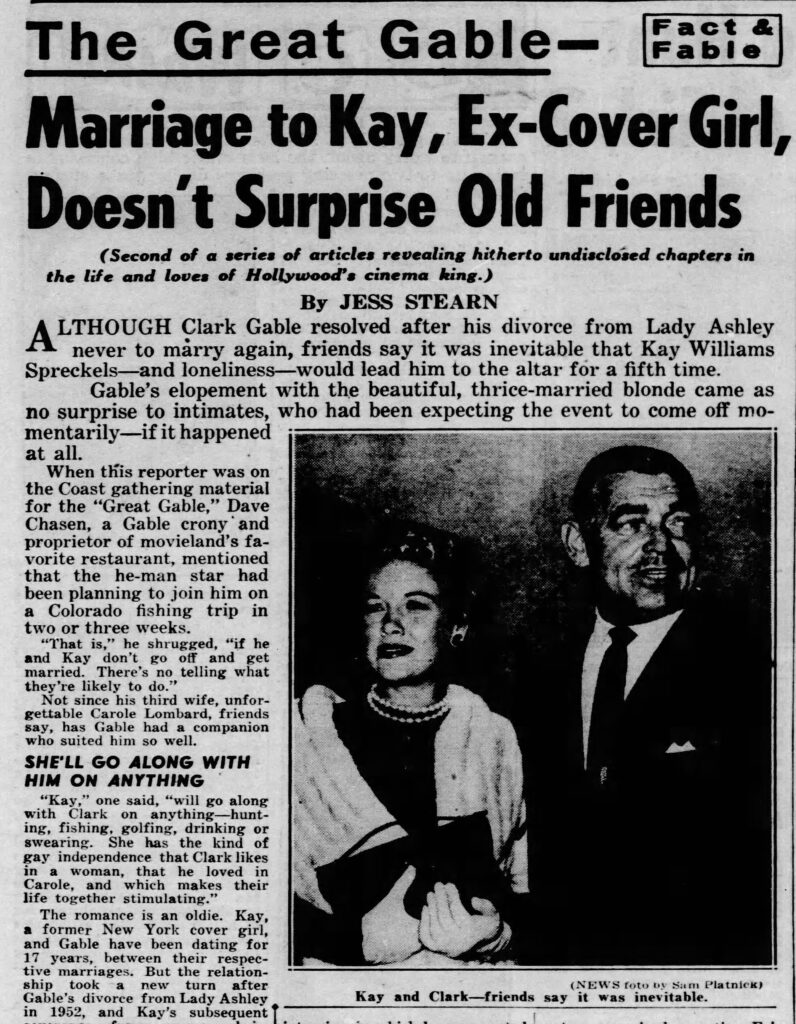
Although Clark Gable resolved after his divorce from Lady Ashley never to marry again, friends say it was inevitable that Kay Williams Spreckels—and loneliness—would lead him to the altar for a fifth time.
Gable’s elopement with the beautiful, thrice-married blonde came as no surprise to intimates, who had been expecting the event to come off momentarily—if it happened at all.
When this reporter was on the Coast gathering material for the “Great Gable,” Dave Chasen, a Gable crony and proprietor of movieland’s favorite restaurant, mentioned that the he-man star had been planning to join him on a Colorado fishing trip in two or three weeks.
“That is,” he shrugged, “if he and Kay don’t go off and get married. There’s no telling what they’re likely to do.”
Not since his third wife, unforgettable Carole Lombard, friends say, has Gable had a companion who suited him so well.
She’ll Go Along With Him On Anything
“Kay,” one said, “will go along with Clark on anything—hunting, fishing, golfing, drinking or swearing. She has the kind of gay independence that Clark likes in a woman, that he loved in Carole, and which makes their life together stimulating.”
The romance is an oldie. Kay, a former New York cover girl, and Gable have been dating for 17 years, between their respective marriages. But the relationship took a new turn after Gable’s divorce from Lady Ashley in 1952, and Kay’s subsequent severance from sugar heir, Adolph Spreckels, who had angrily named the actor as a rival.
“By this time,” a friend observed, “Kay had matured to the stage where Gable finds women most attractive. Nearing 40, and being the athletic outdoor type like Clark, she was able to do anything he wanted at a moment’s notice.”
“Another thing—Kay never held herself lightly in her relationship with Clark, and that impressed him too. For instance, before he went to Hong Kong last fall to film ‘Soldier of Fortune,’ Clark had given out an interview in which he was quoted as saying that he and Kay were just old friends and had no marriage plans.
“By the time the quotes appeared in the Los Angeles papers, Clark was already on location—but Kay sent him a stinging note telling him what she thought of being dismissed so casually, and who did he think he was anyway! I guess Gabe got off the hook by saying je was misquoted, and maybe he was—who knows?”
Kay, sometimes called “The Face” because of her blonde loveliness, had three unfortunate bouts with marriage, the first as a teenager in her native Erie, Pa., where she was briefly married to a young but penurious engineer.
In New York, where she did well as a model, she met and married Argentine millionaire Martin de Alzaga Unzue, who is better known as Macoco. It was a stormy marriage, which gave way in turn to an even stormier union with millionaire Spreckels, which even his sugar millions couldn’t sweeten.
The new Mrs. Gable has two small children by Spreckels. But this was no deterrent for Gable, who has always been fond of children although himself childless through four marriages.
Lately, Gable and Kay had entertained friends at his ranch at Encino, where she impressed guests with her complete naturalness and ease.
“You could almost see the idea of marriage forming in Clark’s head,” a guest remarked. “And I thought the only thing holding him back was the fear, based on experience, that marriage might ruin a beautiful friendship.”
“However, you’ve got to remember that a guy like Gable, prominent for so many years, is essentially a lonely man and I imagine the prospect of spending the rest of his life alone, despite all his resolves, was not a particularly enticing one when it started working through his head in the lonely reaches of the night.”
Paradoxically, Gable, while fundamentally a lone wolf, is a friendly man, with a lively interest in others.
During all the years he was King of MGM, the legend of Clark Gable’s inaccessibility grew to the point where he became widely regarded as a male Garbo. Affably aloof was the way reporters most often described him. And when one gained a rare interview with the celebrated star, it was usually with the expectation of a bonus or a raise, as though some sensational news beat had been scored.
When Gable closed the books on 23 years with MGM and moved over to 20th Century to make two profit-sharing pictures, the myth of aloofness was promptly shattered.
MGM Dictated His Attitude, He Says
He gave out freely with “career” interviews, and recently turned down a publisher’s $100,000 offer for a life story, only because he felt he couldn’t take the money and then insist on exercising censorship here and there.
This apparent reversal in attitude perplexed one interviewer, who found the star as gracious off the screen as on.
“What,” he was asked, “changed your attitude toward publicity—the fact that you’re in business for yourself?”
Gable grinned. “I haven’t changed,” he said. “MGM didn’t want me interviewed.”
Gable, who once starred opposite Garbo in the immemorable, “Susan Lenox: Her Rise and Fall,” has sometimes suspected that the silent Swede, whom he always found pleasant and unassuming, may have been the victim of a similar “mystery” buildup by the studio.
“I once told the publicity department,” he chuckled, “that I thought they were giving her the same treatment.”
However, never one to suit a press agent’s fancy, Gable would hardly have submitted to anything like Garbo’s inane, “I want to be alone,” trademark of the sphinx-like actress’ traditional isolation.
Wary from long prominence of being used by opportunists, he generally fraternizes with other stars—fellow he-man Gary Cooper, who recently visited him on set to talk up a hunting trip; dancer Fred Astaire, with whom he occasionally turns out at the track, and such robust characters as John (Duke) Wayne and Fred MacMurray, hearty outdoor types cast in a similar mold.
He is constantly sought after by self-promoters. Even at the 20th lot, starlets pick out tables near his at the studio commissary, on the chance that he may notice them.
Gable Is Fond of Children and Animals
Perhaps all this explains his liking children and animals, both short on guile.
When he was motorcycling around the California countryside after the war, he would sit and talk cycling with teenagers by the hour. Small-fry neighbors love to congregate at the Gable pool on his 20-acre ranch in the San Fernando Valley.
Gable, asked about this beneficence, responded in gruff embarrassment:
“Just the neighborhood kids, who don’t have pools of their own—and so log as they behave and don’t get themselves drowned.”
Friends constantly indulge his fondness for animals, which has led to complications of beauties and beasts. On his 54th birthday in February, actress Grace Kelly sent him a shaggy burro, named Baba after a native who had amused them during the filming of “Mogambo” in Africa.
Kay Williams Spreckels, who just became Mrs. Gable, gave him a rare Hungarian hunting dog, a breed known as Draga, for Christmas, touching off events that vividly illustrate the former farm boy’s affection for animals.
“At first,” a friend relates, “the Draga got along with Clark’s two dachshunds, including 12-year-old Rover Gable, who varied the hidden-ball trick by ‘hiding’ the ball in the open, and then makes believe he’s searching all over for it, while Clark howls his head off.
“But during the winter, Clark took the hound to Mexico for three weeks of hunting, and being alone with Clark all that time, the dog became jealously devoted to him.
“When they got back to Encino, the Draga wouldn’t let the two dachshunds come near Gable. For the sake of the small dogs, Gable reluctantly sent the Draga back to board at the Milwaukee kennel where Kay got him.
“Now, as soon as he can get away, Clark is heading for Milwaukee, where he hopes to work with the dog to cure his jealously, and perhaps take him back.”
As a mark of his indestructibility, the ageless star’s intimates speak of him as “The Moose.” Neither time, mileage, nor his own fast pace seem able to bend the rugged Gable frame or seam the Gable visage.
“It must be his metabolism,” a writer friend observed. “Hell, you’ll sit there discussing a story with the man, and the next thing you know he’s finished a bottle, and you’d never know it, except for it being empty.
“And the next day, bright and early, while you’re trying to sleep it off, he’s out on the golf course complaining because he isn’t breaking 70.”
There was a report that Gable, dieting rigorously on steak and tomatoes and working strenuously, was warned by his doctor to cut down on partying.
Doctor’s Warning Came At Good Time
Newsmen promptly checked with the patient. “Yeah,” Gable grinned, “I heard about it—I was having a highball at the time.”
Because he has stood for so long a sort of man’s man writers traditionally write him off as an uncomplex masculine type and patronizingly lose sight of the fact that he is an accomplished actor, trained in the hungry school of stock, Broadway and traveling companies, touring once with Jane Cowl in “Romeo and Juliet.”
While he is in position to make his own rules, he works with the zeal of the rankest novice. A meticulous craftsman, he arrives punctually on set, knowing not only his part but every other part in the scene. He is considerate of associates, showing extras the same courtesy he does a director.
Off in a studio wing, I watched him labor at the tiresome task of dubbing dialogue for “The Tall Men,” a Western he is just finishing.
He seemed to be enjoying himself. In a scene, for instance, where he carried hay to his hungry horse, he was supposed to say, gently: “It ain’t like what we grow back in Prairie Creek, but it should help.”
Instead, he made it boisterously Texas, prompting director Raoul Walsh, to accuse the star of ad-libbing. Gable laughed, “Well, anyway Raoul, they’ll see the picture in Texas.”
After “The Tall Men” makes its September premiere in New York, Gable intends to do nothing for six months but hunt and fish with his new bride, and let him 10% of the box office make an estimated million for him.
He takes his vacations seriously. Once asked to what he owed his success, he replied gravely: “My four months’ vacation a year.”
Gable Seems Happy Choosing Own Scripts
After his long reign at MGM, Gable seems happy to be off on his own, choosing his own scripts, his own directors, his own cast.
The parting with MGM was not especially friendly. On one occasion, as his veteran handyman made him up on the 20th lot, Gable observed grimly, “He’s the only thing I wanted when I left MGM.”
At a party on the eve of leaving MGM, coolly ignoring current studio executives, Gable stood and proposed a solemn salute, “To my friends and associates who are no longer alive.”
There are conflicting stories of reasons behind the departure of the greatest moneymaker in MGM history, but Gable himself—for the record—attributes it to a succession of bad pictures since the war.
He professed to know nothing of reports that MGM, itself dissatisfied with his recent pictures, had been planning to “age” the age-defying star gracefully, as it had Gable’s pal and stablemate, Spencer Tracy, who sprang to new popularity after the war in “Father of the Bride.”
Gable’s deteriorating relationship with MGM reaches back 10 years. When he emerged from the war, a major with a distinguished record in the Air Force, he was thrown into the MGM silly, “Adventure,” with MGM ballyhooing, “Gable’s back and Garson’s (Greer) got him.”
Gable still winces over the line, ungenerously rewritten by mags to, “Gable’s back, Garson’s got him—you can have them.”
The picture made money, grossing over $5,000,000 as the King’s fans loyally flocked to the theatres, but even the most loyal, stirring restlessly in their seats, had to acknowledge that MGM had done Gable wrong. It was what is commonly termed a stinkeroo.
Not until the fairly recent “Mogambo,” a remake of Gable’s “Red Dust,” turned out 21 years before, did the King have a post-war picture he himself liked. The picture’s instant success at the box office stirred MGM to the slow realization that the old Gable hadn’t changed, only the picture material they had been giving him.
“Clark was offered everything but the MGM sink, even to sharing the profits, something MGM had never offered before,” relates an intimate, “Eddie Mannix, MGM’s general manager and a friend of Clark’s, was sent to London to win him over, but it was too late—the damage was done.”
Gable now stands alone—and is feeling no pain.
With two pictures, including the current “Soldier of Fortune” getting him 10% of the box office, Gable is now looking forward to a long honeymoon and a third picture, which will make bigger and better vacations possible for two.