In many ways, it was easier to be a star back then. The studio assigned you your films, your co-stars, dictated your schedule; they covered up your affairs, paid off columnists to shoo away divorce rumors and personal scandals, and made sure the pictures of you that were published were only your very best. You were protected.
On the other hand, you were also shackled—by the studio and by the time period itself. This studio system affected the life of most of its stars dramatically—personal choices that most would take for granted were whisked away. If you were gay, your studio set you up on dates with its newest starlet and planted marriage rumors in the columns. If rumors started flying that you were shacked up with someone or had gotten someone pregnant, you’d better believe wedding bells would be ringing as soon as possible. There was a morality clause in that contract you signed and your studio never let you forget it.
In the first contract Clark signed with MGM in 1931, the morality clause read as follows: “The artist agrees to conduct himself with due regard to public conventions and morals and agrees that he will not do or commit any act or thing that will tend to degrade him in society, or bring him into public hatred, contempt, scorn, or ridicule, or that will tend to shock, insult or offend the community or ridicule public morals or decency or prejudice the producer or the motion picture industry in general.” And that very morality clause is the direct cause for Clark’s second marriage.

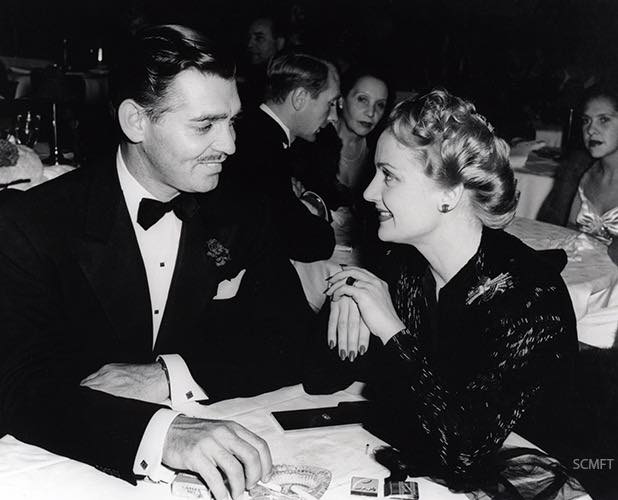
Now that the scandal was avoided and the dust was cleared, I imagine that MGM was not too pleased that their newly minted “Hollywood he-man” came with an older, rather matronly wife. I’m sure they would have much rather had him single, and paired him with every new starlet in their roster to boost both careers. But MGM made the best of it. Story after story printed of how “in love” the Gables were, what a doting stepfather Clark was, etc. They even tried to lower the age of Ria and her children, and always described Ria as “beautiful, glamorous and sophisticated.” Any rumors of them separating (and they began nary a month after the wedding!) were quickly squashed by MGM publicity. If Clark had to be a married man, he was going to be a HAPPILY married man, if MGM had their way.
If you were Mrs. Clark Gable you would have to fight every minute to hold him. Every man and every woman must fight some sort of fight to keep the flame of love burning, steadily—and exclusively. Love is a living thing. It must be fed. It is rank nonsense to say, as some women do say, that if they had to fight for a thing, then they don’t want it. Anyone would fight for anything that is precious—be it a diamond ring or a husband. But there might be fighting to the death. There might be fighting that would exhaust, that would make the combat not worthwhile. There is no sort of sense in fighting, I suppose, when you know the odds are against you. One man would be a fool, not a warrior, if he undertook to engage an army in single combat. One woman would be a fool to resist all other women. And the wife of Clark Gable is, pretty literally, fighting against all other women.I am minded of a party I once attended where Mr. and Mrs. Gable were among those present. And every woman in that large room, from the most prominent stars down to the least significant debutante was ogling and pawing and using all but physical violence to get near Clark Gable. He was surrounded. He was besieged. He was drowned in a sea of perfumed flattery and eyes and lips and would-be caressing hands. He did the best he could. He didn’t seem to be enjoying it. He was dignified and shy and naïve. But there he was. All mean are sensitive to flattery. And Clark would have been a stone man—a robot—not to have felt the adoring flattery that was being lavished upon him. And on the sidelines sat Mrs. Gable, doing her very clever best to looks as if she were enjoying herself, wearing what became a fixed and artificial smile.This same sort of thing takes place everywhere they go. When the attended openings, Clark is all but knocked down by autograph seekers. Young, flower-like girls stand watching him, with half-opened buds of mouths and misty eyes staring at their incarnate dream. Some few will crane curious heads to look at Mrs. Gable. A voice or so will murmur, “I don’t know what he ever saw in her…”Which isn’t any reflection on Mrs. Gable. It wouldn’t be any reflection on you. So high runs the temperature of fan fever that Gable could be married to Lorelei, to Venus, to Garbo and Crawford and Shearer rolled into one and still those thousands of other women would shake deprecatory heads and say, “I don’t know what he ever saw in her…”Nor is Mrs. Gable immune from this sort of thing even in their own home. Women call him on the phone. Women write him letters, the fervid words of which shrivel the scented paper. The perfume of them fills the house even though the words are never read.
The story behind the scenes was far from the portrait MGM painted. Whatever relationship Clark and Ria had before their forced marriage, it was strained to say the least following the ceremony. Clark was angry at what she had done. I suppose he understood her reasoning in a way—I think he did realize that perhaps he “owed” her the marriage, but that didn’t make this cornered bear feel any better. Clark had new fame, new money, an exploding career and Ria was like an anchor he had to drag around on a chain behind him. He dutifully appeared at film premieres with Ria on his arm, waving at crowds.
He did interviews with fan magazines, always mentioning Ria only delicately, giving her credit for being a good wife occasionally, but never oozing with love and adoration. Meanwhile, Clark and Ria were sleeping in separate rooms, across the house from each other. He was always staying late at the studio or not coming home at all. Hidden from the fans by a protective press, Clark was carrying on several affairs with co-stars: Anita Page, Marion Davies and Elizabeth Allan, to name a few. Not to mention the notorious affair with Joan Crawford that everyone in Hollywood knew about…but kept quiet.
The whispers surely hit Mrs. Gable’s ears, but Ria was a proud woman and did them no mind. She enjoyed being Mrs. Gable and all the perks that came with it. Ria and her two children even took a train around the country, waving to fans of Clark’s. She gave interviews depicting their perfect family life and sharing recipes for the things Clark liked to eat. To the American public, the Gables had a perfect marriage, and Ria was confident that, despite what he was doing all those nights he wasn’t at home, that he would always return to her.
The straw that broke the camel’s back was Clark’s brief fling with Loretta Young in 1935 while on location for Call of the Wild. It wasn’t too long after Clark learned of Loretta’s pregnancy that he finally moved out of the Brentwood home he shared with Ria, and into the Beverly Wilshire Hotel. Loretta’s condition was kept secret (for about 60 years!) but the fan magazines fed fans a steady diet of “oh no, how could this have happened to such a wonderful couple who were so perfect together” stories following the Gables’ separation. Ria felt vindicated by these stories, knowing the public was on her side.
This rather ridiculous article, written by Adela Rogers St. Johns ( a friend of Clark’s who knew full well of his numerous affairs) tops the charts as far as syrupy eulogies to their marriage.
The parting of the Gables makes my heart ache a little. I think it does yours, too. Because they were in love with each other, those two. And I know that they expected to live out their years side by side, with love and laughter and courage. I’ve listened to them, in the serene and lovely home Rhea Gable had created, planning things they were going to do, places they were going to see, books they were going to read – always together. Now they are planning to go separate ways and you can see the heartbreak in Clark’s eyes. Because even with all the other women there are in the world, even if a man were the screen’s great lover, it would be dreadful to wake up in the morning and think you’d lost Rhea – because there aren’t any other women like Rhea, at least none I’ve ever met. Why? Why did it have to happen? Why did two such swell people, both of them real, both of them fine, both of them deserving of happiness, have to come to the end of what seemed to all of us who knew them well, all of us who’d been close friends, an ideal marriage? I’ve been sitting here looking out at trees that are bare, but that will be green again in the spring, at lilac bushes that today are brown twiggs but that in April will be fragrance and beauty and color once more, and trying to figure it out. You see, it was like this with the Gables – you felt a wholeness of self when they were together. You felt that they presented a united front to the world and therefore they were safe. I’ve so often noticed them at parties. Maybe they’d be separated the length of a room, the length of a dinner table. Maybe Rhea, stately and elegant in black, would be playing bridge and Clark would be spinning yarns with a gang of men. But every once in a while their eyes would meet in an exchange of sweet understanding, a moment’s greeting, that said, “I’m having such a good time because I know you’re here, in the same room, that we see little things, and laugh over little jokes that belong just to us, and that when the party is over, we’ll go home together to our own home. That’s what really makes everything so nice.” They weren’t sentimental or gushing. They were too modern for that, too casual, as is the fashion nowadays. But your heart felt a little warmer because they were joined in their own way, and the world is often a lonely place and men and women were meant to be one, so that loneliness would roll back like a wave and stand trembling at the command of love. Now the Gables are parted, there’s going to be a divorce.
That was Adela, doing her job, giving the public their fluff and biting her tongue. I have always wondered if the American public bought the whole thing. Probably not.
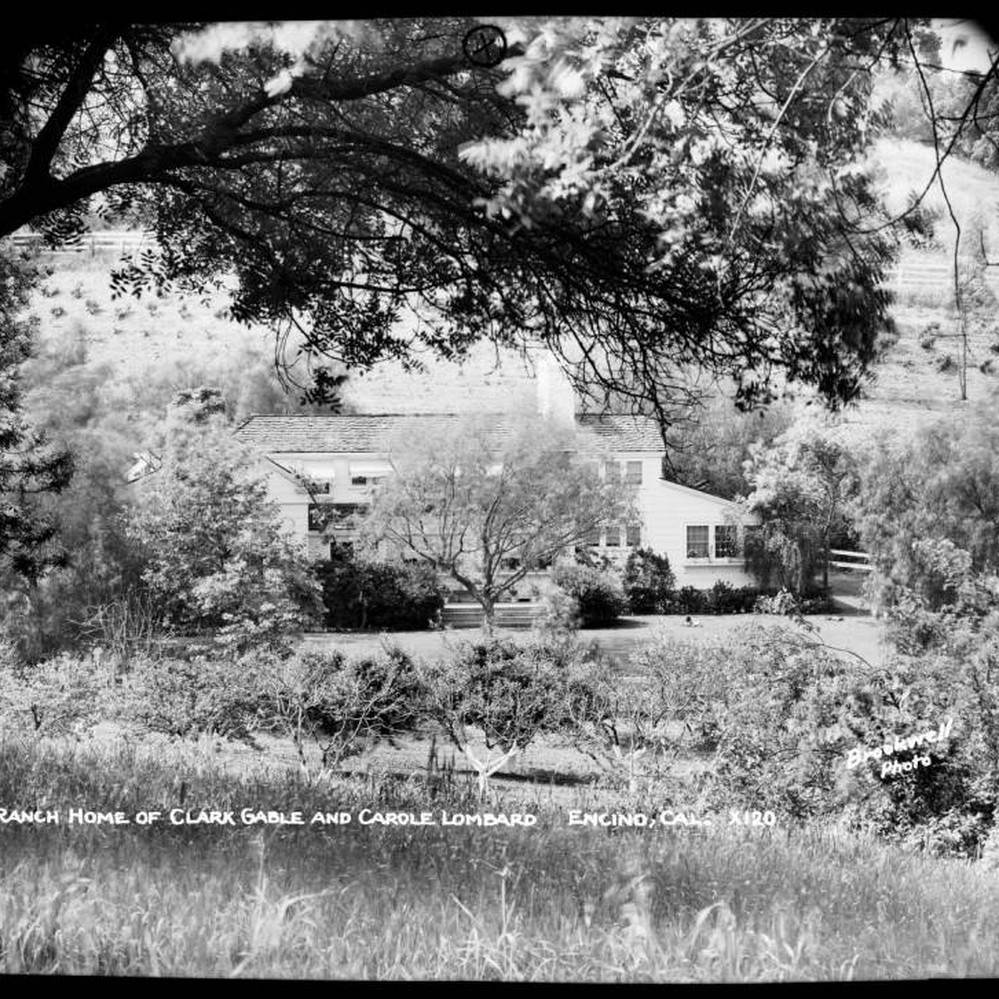
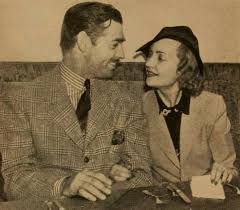
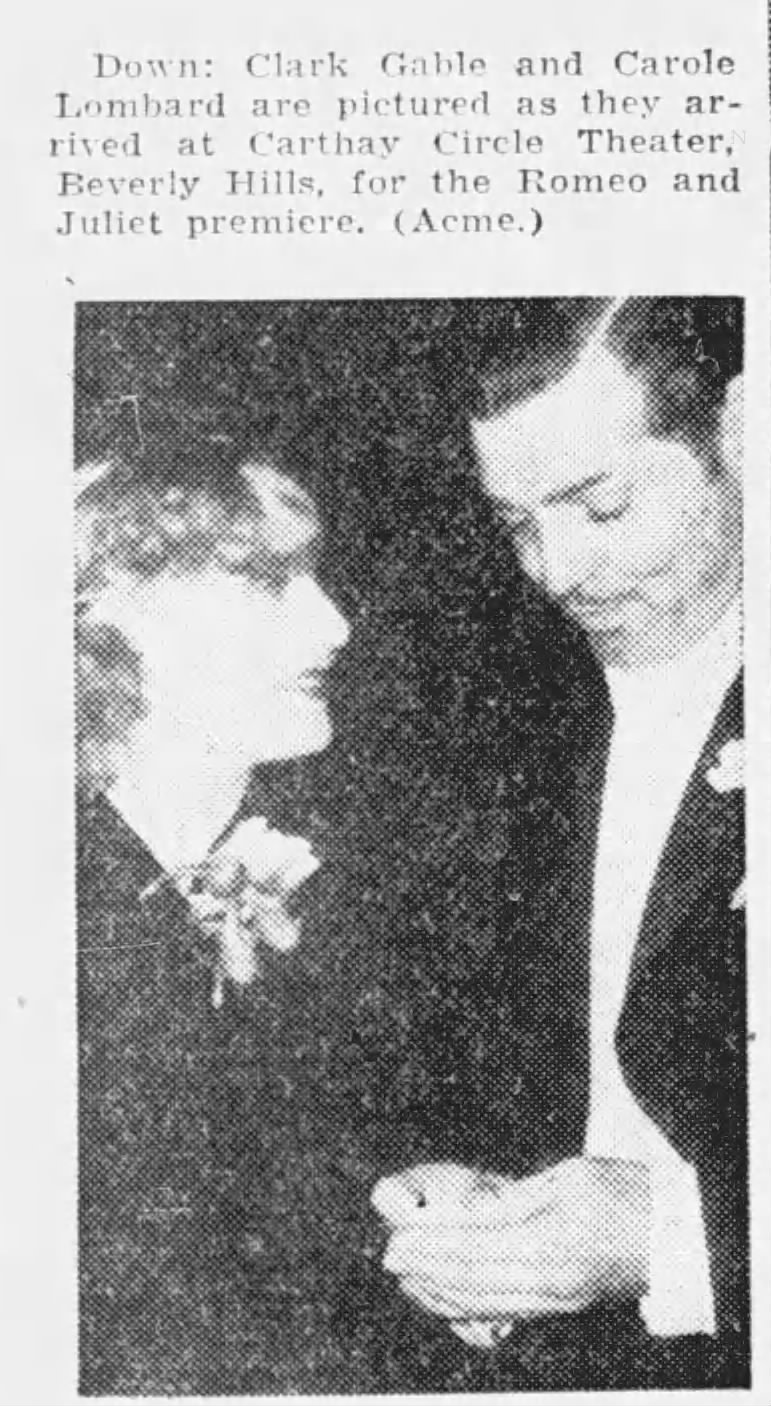
All that changed when a certain Miss Carole Lombard entered the picture the following year. Fans went nuts for this pairing of Hollywood’s favorite screwball beauty and it’s favorite He-Man. Clark and Carole were pictured everywhere together: the circus, the MGM picnic, premieres, at the horse races, at parties. And these weren’t the somewhat stoic premiere pictures that Clark and Ria had posed for—these were lovey dovey puppy love shots of them arm in arm, often gazing into each other’s eyes. Much to Ria’s surprise, the public turned on her. She was no longer the “poor Mrs. Gable who was left by her loving husband”—she was now the stubborn older wife standing in the way of Clark and Carole’s true love.
Clark and Ria were finally divorced in March 1939 (after Clark was able to pay Ria off with a bonus he received from signing on for Gone with the Wind) and Clark swiftly married Carole Lombard a few weeks later.
As for Ria, she stayed around in Hollywood for a while, even dating George Raft for a bit. Then she retired to Houston, where she died in 1966.
This month, Clark Gable is ruthless, one-dimensional Nick the chauffeur to Barbara Stanwyck’s plucky young nurse in Night Nurse.
A quintessential pre-code, the film centers around Lora Hart (Stanwyck) as she struggles to keep her ideals while getting through nursing school. After she graduates, she is assigned to be a night nurse to two little girls suffering from malnutrition and anemia. Clark does not appear until halfway through the film and only appears for a few minutes, as Nick, the evil brute of a chauffeur. Lora becomes suspicious of the doctor treating the children and of Nick. Nick throws her around, bullies her and the children say they are scared of him. Lora soon comes to the realization that Nick and the doctor are in it together–to starve the children to death and keep their mother a drunk so they can get their hands on the family’s fortune. It really is a rather disturbing story. Two little girls who are starving and whine that they are hungry, they want to play but don’t have the strength and they are sad that their mother never comes to see them (even though she’s in the same house and has roaring parties every night, just down the hall!), and all the while are threatened by the house staff that is supposed to protect them. Heinous.
This film is all Stanwyck’s–and it should be. Stanwyck’s little pre-code dramas are some of my very favorites. Their luster lies in their grittiness and reality–something that would be completely lost just a few years later when the powers-that-be put the stop to such alarming storylines as starving innocent children for money. She is in her element, in her bobbed 20′s hair, thick lipstick and calf-length skirt, standing up to the man and telling him what’s what.
Night Nurse is really a pre-code classic in every sense of the word. New nurse Stanwyck is undressing (pretty much a pre-code standard scene!) and a male intern pops in the room. “Oh, don’t be embarrassed; you can’t show me a thing. I just came from the delivery room!” he chides. Ooh la la.
A Free Soul, Clark’s breakout film, has just been released a few months prior to Night Nurse. By the time Night Nurse premiered, Clark was a runaway hit and his days of fourth billing were behind him. But not yet during filming of this little programmer (a short, cheap film usually lumped into a double feature with a bigger, splashier movie). In fact, fledgling Clark was shuffled around, making The Finger Points, The Easiest Way and this film simultaneously, which wasn’t difficult to do since all his parts were small and he was in sporadic scenes. So, Clark was a gangster, a laundryman and a chauffeur all at once!
The part of Nick was so small that Clark doesn’t even appear until 35 minutes in the 70 minute film and is only in about three scenes. James Cagney was originally cast in the role, but after The Public Enemy became a huge hit, he was upgraded from secondary roles so the part of Nick went to then unknown Clark. The role didn’t exactly require a lot of homework for him. Director William Wellman, who would later direct him all of the Wild and Across the Wide Missouri, gave Clark little attention. His only direction to him was: “He’s a loathsome brute.” All Nick’s lines are things like “Why, you little..” “Aw, shut up!” and “Oh yeah?” Not exactly Shakespeare…
Clark is mostly clad in a black uniform, hair slicked back with what I am convinced is Crisco, and his eyebrows penciled in with what looks like a Sharpie. Not exactly his best look. He is young and chiseled, though…
In his first appearance in the film, where he is introduced as a real bad guy by beating up a drunk and thrashing Stanwyck around, he is oddly dressed in the seemingly non-threatening outfit of a Japanese-looking robe and polka dot pajamas!
It’s almost comical when Stanwyck says, “And who are you?” The camera zooms in while Clark says with dramatic pause: “I’m Nick…the chauffeur!” Dun dun dun!
Not to be ignored as Stanwyck’s loyal best pal is Joan Blondell, who often played the best gal pal of the main actress–in fact later would be flirty with Clark and the best gal to Greer Garson in Adventure. Blondell’s got some of my favorite lines, such as when she is teaching Stanwyck the ropes of being a nurse. “Take my tip and keep away from interns; they’re like cancer–the disease is known but not the cure! There’s only one guy in the world that can do a nurse any good and that’s a patient with dough. Just catch one of them with a high fever and a low pulse and make him think you saved his life and you’ll be getting somewhere. And doctors are no good, either. They never marry nurses. And the trouble with interns is they do! All a wife means to an intern is someone to sit in his front office when he starts practice and play nursemaid the rest of her life without pay! The thing to do is to land an appendicitis case–they’ve all got dough!” That’s all you need to know to be a nurse, ladies–that pesky medicine stuff will figure itself out!
I actually find the beginning part of the movie, where Stanwyck and Blondell are working in different parts of the hospital, to be more entertaining than Nick-the-evil-chauffeur-who-must-be-stopped!
Ben Lyon is Stanwyck’s love interest and he’s a bootlegger with gangster connections–tsk, tsk. But hey, being a bootlegger is a far better thing than being a devious chauffeur out to murder little children, eh?
Nick, poor Nick, must meet his comeuppance for being evil and is hastily killed off, making this one of only a handful of films in Clark’s long filmography in which his character dies. The ending is rather a cop-out–I’m still not sure who exactly is going to look after these children now? Their father is dead and their mother is still a ditzy drunk who couldn’t care less.


Night Nurse is available on DVD in The Forbidden Hollywood Collection Vol. 2, along with A Free Soul and several other excellent pre-codes.
You can read more about the film here and see pictures from the film in the gallery.
From September 1937:
Swell Gesture: Hearing a property man bragging about his son, Gable asked if his son had a bike. “Not yet, but when I get the money saved, I’m buying him one,” said the prop man.
Next day, Clark wheeled onto the set on a new bike. “How ya like it?” Clark asked he prop man. “Finest bike I ever see,” answered the man., “whose is it? Yours?”
Answered Gable: “Nope, it’s your son’s, with my compliments.”
In case you have ever sat and thought to yourself, “I wonder how Clark Gable spent his Saturdays eighty-one years ago?” I have the answer! In this probably-mostly-made-up article from 1932!
At this point, Clark’s stardom was exploding and the MGM powers-that-be figured out that they couldn’t paint him as a nightclubbin’ man about town, no matter how hard they tried. So they went with the opposite approach: Here is your hearthrob Clark Gable, a man who woos Joan Crawford and wears tuxedos all week at the glamorous movie studio, but on the weekend schelps around town like an every day Joe!
Here is is Saturday schedule:
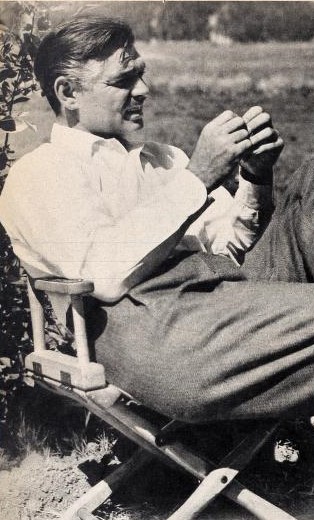
It is somewhere between nine and ten am of a Saturday morning—a non-working day in the life of Clark Gable. He is in his bedroom in his apartment at the Colonial House in Hollywood. He doesn’t need an alarm clock. He wakes up when he has planned to wake up the night before. And he wakes instantly, alive, alert, sleep gone. No “one more naps” for him. No stretchings. No deferrings. He rises swiftly. He takes a cold shower. He sings under the icy spray. Songs he doesn’t know the names of, nor the words. He just “makes a noise.” Any Saturday morning between nine and ten when he is not working you may have this mental and vocal picture of Clark Gable before you and it will be a true one.
10:00—“Breakfast”—the word breakfast is in quotes because Clark never eats any breakfast. Never. Not for dietary reasons. Just because he doesn’t like the thing. He always has one cup of black coffee, no more, no less. He takes it sitting on the edge of hid bed, talking to his wife, or to his small step-son and best pal.
10:30—Still in dressing gown and pajamas Clark takes his favorite bedroom chair and has a look at the two morning papers, the Times and the Examiner. He does NOT read the stock quotations. Because he has no stocks. He does not read the local news, not even the Hollywood section. He reads the telegraphed news first and reads it thoroughly. Things that do not concern him personally. A rare trait in an actor.
He finishes the papers and reads his mail. NOT his fan mail. His secretary attends to that, saving for him letters of importance, and these he takes care of at the studio. Personal letters from old friends he reads—and answers. Clark never forgets and never neglects the friends of other and less fortunate days. He is never interrupted in the reading of his mail or at any other time by the telephone, because he never answers the telephone. If he is forced to talk business for some reason he confines himself to brief yeses and nos. He dislikes intrusive instrument.
11-11:30—He dresses in knickers, sweater and scarf-all old and well worn. And he takes his two dogs for their daily walk. A chow christened Wu and a Scotty named Laddie. Sometimes they walk round and round the block at a brisk clip. Sometimes they strike into the Hollywoodland hills. Almost always Clark’s young step-son accompanies them. The boy goes to a military school but always comes home on weekends at Clark’s special request.
12:30—Home again. And then, for fifteen minutes to half an hour or as long as he has before luncheon is served he reads. He doesn’t read to improve his mind or to astonish with learned quotations. He reads a lover of books always reads—for the sheer pleasure of it. He never reads modern novels, seldom reads fiction. Mostly he reads poetry. Not the pretty Valentine poetry of lovers knots and moonlight and roses, but the more virile poets: Masefield, Robert Frost, Robinson Jeffers. And as he reads he marks the passages that especially appeal to him so that he may go back to them again when leisure comes his way. He reads biographies and histories and philosophies. He reads whatever he feels like reading at the moment and never what anyone tells him to.
1-1:30—“Luncheon”—and again I use the quotes because, when he is not working, Clark never eats lunch. He sits at table with his family in order to be sociable and for no other reason. Occasionally he will have another cup of coffee or some fruit and that is all. Very seldom is the family talk of the studio or of anything connected with Hollywood. They talk of the boy’s school and of the daughter’s activities. They talk about polo and the books they are reading and flying and Bridge. They talk about guns and hunting and dogs and horses. A listener-in—as you are now—and you—and you—would never believe that they are listening to the table talk of an actor.
2:00—This hour of the clock is always reserved for one of four things. Clark plays polo. He plays tennis or golf. Or he takes the boy and the dogs, piles into the roadster, boy and dogs in the rumble, and they are off. They ride. They speed. They make the wind a laggard thing vainly trying to keep up with them. They never talk. The glory of wind and speed is sufficient for them. He is utterly content when he is at the wheel.
5:00-5:30—Clark is home again. Sometimes with Mrs. Gable and sometimes alone he rambles up and down Hollywood Boulevard, poking into bookshops, turning the pages of volumes that interest him, buying one here and there, at random, to add to his library at home. He likes to watch the faces of the people they pass. He tries to avoid being recognized. When he is, the hour is spoiled for him.
6:00-6:30—He is home again, and this time, before dinner, he gives to reading. When he is at home he smokes a pipe. He does not dress for dinner other than to make the concession of removing the old, worn sweater and adding a coat.
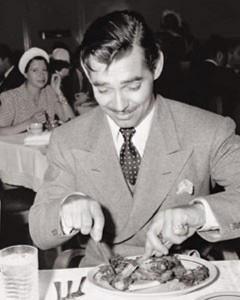
7:00—Dinner hour. It is always a strictly family dinner. Rarely if ever are there guest. And always Mrs. Gable plans to have Clark’s favorite dishes. Soup first. A thick cream soup, cream of tomato or cream of mushroom. A steak, also thick, onions. A green salad. One or two vegetables. Pie and coffee for dessert. A large substantial dinner for a man who is, by this time, ravenously hungry.
8:30—There are two guests—for bridge. They play contract for a tenth of a cent a point. Clark loves bridge. The guests who play with them are not professional people. They have one or two high-balls as the evening progresses. They play until midnight of shortly thereafter. That is as late as Clark can manage to stay happily awake. They have sandwiches and coffee, and so to bed.
Midnight—Clark is in bed at this hour or soon thereafter. When he is working he is always in bed at nine. He reads before he switches off the light. He may read one paragraph or half a book through, but he always reads something for a short space of time. He closes the book, the lights are out and the clock has ticked off the waking hours of a day at home with Clark Gable.
A few things stuck out at me about this timetable:
Maybe at this point in his career and at this point in life, when he lived in an apartment, Clark was a late sleeper. But when he was on the ranch, he was always an early riser.
I sincerely doubt that Clark never ate breakfast or lunch. He was a man who liked to eat, at any age! I can’t imagine him not eating until dinner, no way. The description of the pot roast seems to be just like this article in which Ria details Clark’s favorite foods–and it’s worth mentioning that in that article Ria also describes Clark’s hearty breakfasts and lunches!
I also tend to think that the press exaggerated Clark’s relationships with his stepchildren. It seems to be me that he was kind to them, but I don’t think he was an overly doting stepfather at this point.
The reading and the bookstore are probably true; he was always a big reader. There aren’t many bookshops on Hollywood Boulevard for Clark to wander in and out of nowadays, that’s for sure!
I’m sure there are some truths here in his little routine, but I am doubtful that Clark let a reporter follow him around on a Saturday!
You can read the article in its entirety in the Article Archive.
From April 1936:
Clark Gable did two things this month that may interest you—he brought back the style of wearing big striped bow ties for street wear—and he slapped down $16,000 for a new Deusenberg auto—and he looks so, so bored while driving it. Can you imagine that?
From September 1940:
Players who came to the Hollywood feast early get most of the gravy. The highest salaries go to firmly established stars like these:
Clark Gable hits the cash register for about $7,500 weekly, 52 weeks a year, with fat bonuses.
Ronald Colman pockets $150,000 per picture, plus 10% of the world gross when it goes over a certain amount–and it usually does.
Robert Taylor brings Barbara Stanwyck an envelope containing about $5,000 weekly, plus bonuses.
Bette Davis earns not less than $3,500 a week the year round.
Deanna Durbin, who blossomed before the economy blight, earns over $2,500 a week, and bonuses.
Claudette Colbert draws $150,000 per picture.
Jimmy Stewart gets about $2,500 a week–and a crack at that bonus.
Due to Hollywood;s reluctance to reveal actual salaries, these sums are estimated on the basis of information supplied by reliable sources.
Hardly threatened with starvation, these stars still can’t approach the Arabian Nights scale of living once rampant in Hollywood:
Linda Darnell has climbed from $110 to $350 a week within the last year. It will be a long time before she reaches the $1,500 mark.
Mary Beth Hughes collects $350 a week for mugging with John Barrymore.
Carole Landis, much publicized, earns $350 weekly for the same sort of role that brings Carole Lombard $150,000 per picture.
Robert Stack gets about $250 a week, opposite Durbin and Dietrich. Robert Montgomery’s greater fame, experience and ability would rate $4,000 weekly for the same work.
Hedy Lamarr, as well known as Colbert and Garbo, earned $750 weekly a few months ago, now gets $1,250, may never reach $5,000.
From October 1936:
Did you ever hear Clark Gable’s grand crack, after he’d lectured before a class at Vassar? Asked how he’d enjoyed the experience, Clark grimaced, replied: “I’d rather talk a thousand times to one girl, than one time to a thousand girls!”
Clark Gable’s relationship with Jean Harlow was adorable. It wasn’t some great love affair like some people like to claim; it was a buddy-buddy, brother-sister relationship. He was always looking out after her, teasing her, and while everyone else called her “Baby,” he called her “Sis.” I like to point to his relationship with Jean when people say that he was some kind of predatory womanizer, like he bedded every co-star he had. Unfortunately, Jean was also one of the many women in Clark’s life who were special to him and then left him far too soon.
This article is an interview conducted on the set of Wife vs. Secretary. While there aren’t any grand revelations here, it is still sweet to hear Jean and Clark banter!
I said to Jean and Clark, “What I want to know is this—what dreams did you two dream when you were making your first picture together back in the Neolithic age? Did you dream that it would come to…this?”
And I indicated, comprehensively, the small deluxe dressing room. Jean’s maid hovering in readiness, Clark’s man proffering him a gold cigarette case, the stand-ins standing at attention—the whole luxurious frame of stardom…
And before the question was out of my mouth they answered in union, “We didn’t!”
“Nope,” said Clark, “I can answer for both of us and if I’m wrong Jean can stop me. We didn’t have a dream in our heads. We didn’t even think about a tomorrow but only of the day itself. We never thought about being stars. We knew that there were such animals and we admired them, respectfully, but at a distance. For never once did we think of ourselves as potential stars, or any kind of stars at all. Fact is, we didn’t think about it all. While as for dreaming…well, dreams don’t sit so well on an empty stomach.”
“I still can’t think of myself as a star,” said Jean, “sounds silly but it’s a fact that I never think of me as a star. I find myself thinking of Garbo and Dietrich and Colbert and Crawford and others as big stars, and then the thought comes, ‘but you’re a star, too’—and it doesn’t ring the bell. It doesn’t see, to be real!”
“Doesn’t sound silly to me,” Clark said, “because I feel the same way myself. Always have and always will.”
“Clark hasn’t changed one mite,” Jean said, with an affectionate smile and her fellow star, “since his almost unparalleled success came to him. He’s just the same today as he was that first day in The Secret Six. My chief recollection of him then is the way he threw hard rolls at me in one of the scenes—and then between the scenes, ‘just for fun’…FUN! He got realism into those rolls, believe me. He aimed ‘em with deadly precision. He gets realism into falling on the ice, too, as my fair limbs will doubtless bear witness tomorrow. What I mean is, we fall—and fall again…”
“And Jean hasn’t changed either,” Clark said. “In the beginning she wouldn’t have thought of allowing anyone to take the blows for her. She doesn’t think today of having anyone take the falls for her…
“No, you see in the days of The Secret Six we just thought, Jean and I, that we had jobs and were darned lucky to have ‘em. Our only hope was that there would be another job for us when the current one was finished. We never got beyond that point…”
“At the risk of being called an Elsie Dinsmore or something,” Jean broke in, “I was really thinking only of my mother then…of the sacrifices she had made, of the family opposition she faced when we came to Hollywood. I was just hoping, from hour to hour, that I would be allowed to keep on working, for her sake. Just as I would have felt if I’d been a stenographer or had any other kind of a job. I also had the hope that after a good many years and a lot of hard work I might develop into the kind of an actress I’d like to be. But of stardom, of great success, of all the glamour that went with the Garbos and the Loys I never had a thought or a dream. I just didn’t place myself in their category at all. I didn’t have time to dream…”
“I was thinking of my tummy,” grinned Clark, “and what steady jobs could mean to it!”
“But it was fun,” Jean said, blue eyes wistful, almost wishful for the departed days when she and her mother shared a modest home and a very modest hopes; when Clark used shoe leather instead of a new Dusenberg for transportation.
“Well,” I commented, “I have picked two honies! If you don’t dream of stardom for yourselves, individually, didn’t you think of it for each other?”
“Whad’d you mean?” asked Clark, blankly.
“I mean, didn’t you, Clark, gaze upon the platinum blonde glory that was Jean and say to yourself, ‘Here is the next big box office Glamour Girl! Here is a rising star! Here is the studio’s next gift to the fans?’”
“I did NOT,” retorted Clark, with the ruthless and unprettified honesty which characterizes everything he says, “I thought she was a nice kid but a rotten actress and that was as far as I went in thinking about her at all.”
Jean laughed.
“And you?” I turned to her, “did you think when you looked at Clark that he was to be the biggest star sensation since Valentino? Did you know…?”
“Imagine my embarrassment,” grinned Jean (they reminded me, the two of them, of high school kids playing Truth), “but honestly—NO! I didn’t think about him at all. I mean, I thought that he was just another actor, and not such a hot one at that, with a job. I thought he was a lot of fun and I took his advice only because I always take advice from everyone…”
“It wasn’t until we made Red Dust together,” Clark cut in, “that I realized Jean was an actress to be reckoned with, a comer, a star…she had improved so vastly by that time that even a blind man could get a glimmer of the glamour…a glamour of the glimmer…y’know.”
Clark and Jean were very similar in that the public’s perception of them, as they were in films, was way off. Jean was this painted-up floozy on the screen, while in real life she threw on sailor pants, a t-shirt and no makeup to go golfing. Clark appeared to be the epitome of the elegant man on the screen, while in real life he couldn’t wait to throw on khakis, hop in a station wagon and head out fishing.
You can read the article in its entirety in The Article Archive.
From December 1935:
Clark Gable lost a dog. It had an identification tag on his collar. Quite soon, Clark received a letter from a Beverly Hills boy named Johnny Marks.
“Dear Mr. Gable,” wrote Johnny, “I found your dog and I’d like to keep him.” He offered the best of care. Whether Clark decided such gall deserved a reward, the fact remains that he sent a message, telling Johnny to keep the dog.
This month, Clark Gable is a womanizin’ oil chaser, Spencer Tracy is his long-suffering best pal, Claudette Colbert is his best girl, and Hedy Lamarr is his sidedish in Boom Town.
Gable is “Big John” McMasters and Tracy is “Square John” Sand, or as Big John calls him right from the beginning, “Shorty”. They are two wildcatters out west trying to strike oil. They pool their money and smarts and soon hit it big. Putting a snag in their festivities is the arrival of Elizabeth or “Betsy” (Colbert), Shorty’s sweetheart from back home. She arrives to see him but falls in love with Big John instead, and they are married the night they met.
A year passes and when Shorty thinks that Big John is not treating Betsy right, the two men come to blows and flip a coin to decide who gets the oil rigs. Shorty wins and Big John and Betsy hit the road. The film follows them through the years as Big John and Betsy have a son and strike it rich, first in Oklahoma, then in New York. Shorty also strikes it rich but soon loses it all. When the two men meet again and decide to let bygones be bygones, their friendship and working relationship is tested again when Shorty discovers Big John is having an affair with the elegant Karen VanMeer (Lamarr).
The film is rather melodramatic, but the cast is fantastic and it keeps your interest even if oil drilling isn’t exactly your idea of a thrilling topic.
The film has all the ingredients for the perfect Clark Gable stew: he gets dirty, he throws punches, he juggles two gorgeous girls, and he’s kind of a cad through it all but in the end it all works out a-ok for Clark.
Clark and Claudette, the Oscar-winning duo from 1934′s It Happened One Night, are re-teamed here for the second (and last) time. The chemistry hasn’t faded for these two–they still fell easily into the roles of two people very much in love.

One of my all-time favorite Clark Gable scenes is in this film. Claudette, torn between her obligation to her childhood beau Spencer and her newfound love for Clark, runs up the stairs to her hotel room and away from his embrace.
Clark at first seems confused but then says softly–but firmly, and with an almost pleading look in his eyes, “Hey! Come down here.” When Claudette obliges, he informs her, “I make up my mind quick. I made it up when I first saw you I guess. You aren’t ever going to leave.” Just try and resist that!
Spencer Tracy is again playing Clark’s conscience, much as he did in San Francisco. He is left to be the one shaking his head at Clark’s actions and trying to steer him down the right path. Clark and Spencer were “frenemies” of sorts–considered themselves very close friends but at the same time envied each other. Clark was jealous that Spencer was so highly regarded as an actor, and Spencer was jealous of Clark’s popularity and hearthrob status.
In this film, Clark and Spencer get to beat each other up in a rather hokey fight scene. Throwing fake punches and breaking furniture right and left, Spencer throttles Clark for cheating on Claudette with Hedy. Hokey and makes some amusing screenshots!
While filming the fight scene, Spencer’s stand-in accidently smacked Clark square in the mouth, breaking his dentures and cutting his lip–causing a delay in filming.
Hedy Lamarr is pure window dressing in this film. But if anyone could be good looking window dressing, it was Hedy! She was very nervous about the role and apparently Clark often had to reassure her. Their scenes together were steamy enough that MGM quickly reteamed them in Comrade X.
Boom Town was filmed during what was probably the happiest time of Clark Gable’s life. Riding high on the recent success of Gone with the Wind and in a newlywed bliss with Carole Lombard, Clark had never looked better.
Boom Town is available on DVD in The Clark Gable Signature Collection. Read more about the film here and see over 200 pictures from the film in the gallery.

Welcome to Dear Mr. Gable, the site that celebrates The King of Hollywood, Clark Gable.
Follow
Subscribe for e-mail updates
The Gable Gallery
Filmography
Article Archive
Radio Shows
What I’m Reading and Watching
Categories
Disclaimer
© 2009-2013 Dear Mr. Gable | dearmrgable.com, all rights reserved. This site was created for educational purposes and is in no way affiliated with the family or estate of Clark Gable. No copyright infringement is intended.
- About Clark Gable
- Filmography
- Article Archive
- Info
- Radio
- Links
- Contact
- Subscribe2
- What I’ve Been Reading and Watching
- Radio Shows Index
- Miscellaneous Radio Appearances
- The Silver Theater
- March of Dimes
- Mail Call
- Good News
- The Gulf Screen Guild Theater
- Lux Radio Theater
- The Chase and Sanborn Hour
- Greek War Relief Benefit
- Command Performance